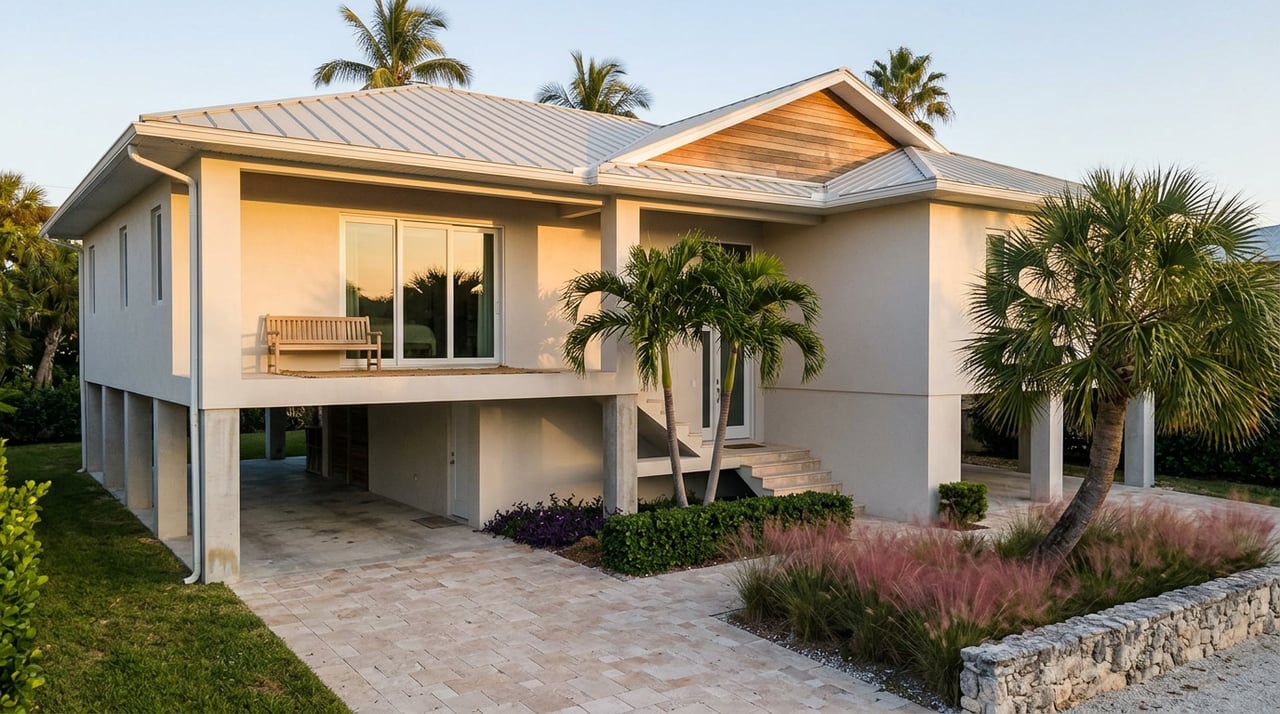
Two houses sit three doors apart on the same Siesta Key street. Same flood zone, same walk to the beach, same decade of construction. One can legally take a guest for a long weekend and collect nightly rate. The other cannot rent for less than thirty days, no matter what the listing photos promise or what the previous owner was doing before anyone noticed. The difference isn't the address. It's a zoning classification buried in the county's parcel record, and it's the single fact that decides whether a Siesta Key purchase behaves like a vacation rental or like a long-term lease with better views.
Buyers chasing rental income on Siesta Key tend to shop by reputation. The beach has been ranked the best in the country more than once, tourism is constant, and the assumption follows naturally: an island this popular must be built for short-term guests everywhere. It isn't. The capacity to legally host a week-long rental is rationed by a zoning line that has nothing to do with proximity to sand and everything to do with a designation written into Sarasota County's code decades ago.
The Line Runs Through Zoning Maps, Not Neighborhoods
Unincorporated Sarasota County, which covers most of Siesta Key, sets a 30-day minimum lease on residential single-family (RSF) zoned parcels. That rule applies whether the house is a block from the Village or tucked into the quiet south end near Turtle Beach. The one exception is Residential Multi-Family (RMF) zoning on the barrier islands, where sub-30-day stays are permitted. Siesta, Casey, and Manasota Keys share this same carve-out.
Florida generally forbids local governments from restricting how often or how long a property can be rented. That preemption law took effect in 2011. Sarasota County's 30-day rule survived it only because the ordinance predates the cutoff, June 1, 2011, and grandfathered rules were locked in place. Everything built on top of that rule since has had to work around a floor that state law can't touch.
A rule written before a single line of the state's preemption law existed is the reason Sarasota County can still say no to nightly rentals on most of Siesta Key's single-family lots.
That's worth sitting with. The zoning line isn't a modern reaction to overtourism. It's an accident of timing that happened to land on the right side of a legal deadline, and it now shapes where every dollar of short-term rental income on the island is allowed to go.
Why the Rental Economy Lives Almost Entirely in Condos
RMF zoning on Siesta Key concentrates in the island's condominium buildings, not its single-family stock. According to the 2022 county tax roll, unincorporated Siesta Key carried roughly 2,381 single-family homes against 6,793 condominium units. That imbalance means the overwhelming majority of parcels capable of legally hosting a nightly guest were condos from the start.
A quick way to see the split:
| Zoning | Minimum Stay | Governs | Added Layer |
|---|---|---|---|
| RSF (single-family) | 30 days | Sarasota County | Siesta Key Overlay District parking and buffering rules still apply |
| RMF (multi-family, barrier island) | Under 30 days permitted | Sarasota County | Siesta Key Overlay District plus each building's own association documents |
A small stretch of Siesta Key's north end actually falls inside the City of Sarasota rather than the county, where the rule set flips entirely: registered vacation rentals there follow a 7-night minimum instead of 30 days, under an ordinance the city has been actively refining. As recently as March 2026, the Sarasota City Commission voted to extend its vacation rental registration requirement to another downtown zoning district, a reminder that the city side of this boundary keeps moving even while the county's 30-day rule for Siesta Key's single-family lots has stayed fixed for years.
The Feedback Loop Lenders Watch For
Once a building sits in an RMF zone and its association allows short stays, it tends to attract a specific kind of buyer: someone underwriting the purchase primarily against rental income rather than personal use. That pattern compounds. Heavy investor concentration and low owner-occupancy inside a single building are two of the flags Fannie Mae's condo project standards watch for, and a building that trips them can lose conventional financing eligibility for future buyers. When that happens, purchases in that building start skewing toward cash, which pushes investor concentration even higher.
None of this shows up on a listing sheet. It shows up when a buyer's lender runs the building through Fannie Mae's Condo Project Manager and gets flagged for exactly the ownership pattern the zoning helped create. Confirming a building's current financing status before writing an offer isn't a formality on Siesta Key. It's checking whether the zoning-driven rental economy has already reshaped who can even buy in.
What Changes Once You're Inside the Building
RMF zoning is permission, not a guarantee. Condo and HOA documents can impose tighter rules than the county allows, and many do, including minimum stay lengths longer than 30 days or outright rental bans inside buildings that sit in otherwise rental-friendly zones. Florida law offers a layer of protection here worth knowing before you sign anything: under Florida Statute 718.110(13), rental amendments generally apply only to owners who consented to them and to buyers who take title after the amendment's effective date. Read the amendment history, not just the current rule, because your rental rights may depend on when you bought rather than what the association allows today.
New owner waiting periods are common too, often six to twelve months before an association will let a fresh purchase go on the rental market at all. That detail matters most for buyers modeling rental income starting the month after closing.
The Number That Actually Moves Your Net
Even in a building where short-term rental is fully legal, the tax stack takes a real bite. Florida's state sales tax plus Sarasota County's Tourist Development Tax combine to roughly 12 to 13 percent of gross short-term rental revenue, on top of any local business tax and the annual cost of state licensing through the Department of Business and Professional Regulation. That's before management fees, turnover cleaning, or the insurance premiums that barrier island properties carry.
For condo buildings three stories or taller, there's a newer wrinkle that has nothing to do with zoning and everything to do with disclosure. For contracts entered after December 31, 2024, a missing milestone inspection report or Structural Integrity Reserve Study can make the purchase contract voidable. If you're underwriting rental income against a building's financial health, those documents are exactly where that health gets proven or exposed, and skipping them in due diligence is a different kind of risk than getting the zoning wrong, but it's just as capable of turning a rental projection into a liability.
Before You Write the Offer
- Pull the parcel's zoning designation directly, RSF or RMF, and confirm whether it sits in unincorporated Sarasota County or the City of Sarasota.
- If the property is in an RMF zone, request the association's current rental policy and the amendment history, not just a verbal confirmation that "short-term is allowed."
- Ask for the building's Fannie Mae Condo Project Manager status if you plan to finance conventionally.
- Request the milestone inspection report and Structural Integrity Reserve Study for any condo building three stories or higher.
- Confirm any new-owner waiting period before you assume rental income starts at closing.
- Model net yield after the roughly 12 to 13 percent combined tax burden, not gross nightly rate alone.
A Few Direct Answers
Can a single-family home on Siesta Key ever be rented short-term? Only in the rare case where the specific parcel carries RMF zoning rather than RSF, which is uncommon for single-family lots on the island. The listing description or a previous owner's practice doesn't change what the zoning record says.
Does buying in the City of Sarasota portion of Siesta Key change the rules? Yes. That small northern sliver follows the city's 7-night minimum and registration program instead of the county's 30-day rule, and the city has continued updating that program as recently as this year.
If my condo building allows short-term rentals today, will it always? Not necessarily. Associations can amend their rental policies, though Florida law generally protects owners who bought before the amendment took effect. Reading the amendment history before you close is the only way to know which side of that line you'd be on.
Zoning maps and condo bylaws aren't the parts of a Siesta Key purchase that show up in the photos, but they're the parts that decide whether the investment behaves the way you're picturing. If you're weighing a Siesta Key property against its rental potential, or trying to figure out which building actually matches the income plan you have in mind, Jesse Griffin can walk through the zoning, the building's documents, and the numbers before you're locked into an offer.